
(and what Rent-a-Car can teach us)
In markets where customers have multiple options and need to decide quickly, trust has become one of the key drivers of choice.
Today, that trust is largely built through:
- online reviews
- platform ratings
- customer feedback and NPS
Whether in retail, hospitality, food service, or rent-a-car, the pattern is the same:
when the product is similar, reputation makes the difference.
Despite this, many companies still treat these metrics as marketing indicators. In reality, online reputation has a direct impact on revenue and on the quality of customers you attract.
Why online reviews matter in any operation
There are three main reasons why customer feedback directly influences business performance.
1) They influence customer choice
When customers compare options, the average rating is often one of the first things they look at.
A company with:
4.5 stars and hundreds of reviews
will typically outperform one with:
4.8 stars but only a few reviews.
Customers value consistency and social proof. A high volume of reviews reduces perceived risk and increases confidence in the decision.
Studies show that over 80% of consumers read online reviews before making a purchase. The more similar the offer, the more important reputation becomes.
2) They influence visibility on platforms
Whether it is:
- brokers in rent-a-car
- Google in local retail
- marketplaces
- booking platforms
the logic is the same.
Reviews influence:
- search ranking
- visibility
- perceived trust
In practice:
better reputation = greater visibility = more sales.
3)They support higher pricing
Reputation reduces perceived risk.
Companies with:
- consistent ratings
- a high volume of reviews
- recurring positive feedback
do not need to compete purely on price.
Customers are more willing to pay when they trust the provider.
Across multiple sectors, businesses with stronger reviews can sustain prices 5% to 15% higher without significantly impacting demand.
The problem: feedback is biased
In most operations, the pattern is clear:
- satisfied customers rarely leave reviews
- dissatisfied customers are far more likely to do so
As a result, online reputation is often skewed and does not reflect the true customer experience.
For this reason, review management cannot be passive. It must be part of the operational process.
The critical role of front-line teams
Customer experience is created at the point of interaction.
Whether:
- at the counter (rent-a-car)
- in-store (retail)
- at reception (hospitality)
front-line teams influence:
- customer perception
- trust
- likelihood to recommend
They are also in the best position to ask for a review at the right moment.
A simple example:
“If you had a positive experience, we would really appreciate it if you could leave a review. It helps our team a lot.”
Small, consistent actions create impact.
How to consistently increase reviews
There are three simple practices that work across most industries.
1) Ask at the moment the experience ends
While any positive moment is valid, the end of the experience is typically the most effective.
Examples:
- rent-a-car → vehicle return
- retail → checkout or store exit
- hotel → check-out
At this moment:
- the experience is complete
- perception is clear
- the customer is more available
In rent-a-car, there is an additional layer: many brokers automatically send review requests after the rental is closed. If the customer has already been prompted in person, the likelihood of responding increases significantly.
2) Make it easy
The easier it is to leave a review, the higher the response rate.
Best practices include:
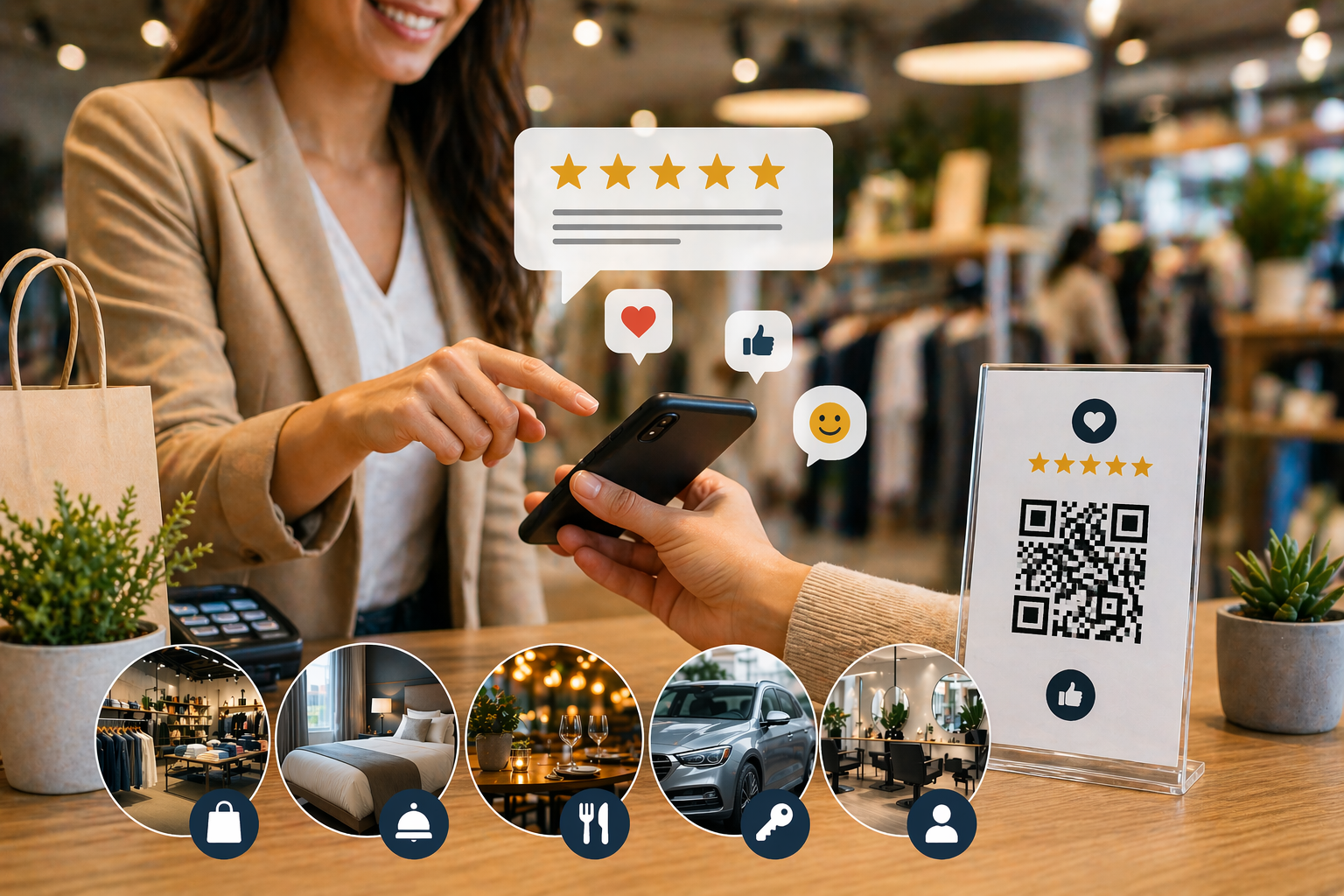
- QR codes at the point of contact
- direct links via SMS
- automated emails
Reducing friction is key.
3) Follow up with customers
A less common but highly effective practice is to conduct post-service follow-ups.
This allows businesses to:
- validate the experience
- identify issues
- resolve problems early
- encourage satisfied customers to leave a review
Beyond improving service, it helps balance and strengthen online reputation.
Reputation does not just bring more customers — it brings better customers
This is one of the most overlooked aspects.
Reputation does not only affect volume. It affects who chooses your business.
Companies with stronger reviews tend to attract customers who:
- value quality and trust
- are less price-sensitive
- seek a predictable experience
- generate fewer conflicts
This applies across industries.
In rent-a-car, it reduces concerns around deposits, insurance, or liability.
In retail, it reduces uncertainty about product quality or service.
In practice, strong reputation improves the quality of revenue.
Online reviews are not just about reputation.
They are a core operational asset that directly impacts visibility, conversion, pricing, and customer quality.
In a context where customers compare multiple options in minutes, a strong rating backed by a high volume of reviews can be the deciding factor in winning or losing a sale.
Companies that treat this as part of their operation — not just marketing — create a clear competitive advantage, regardless of industry.