
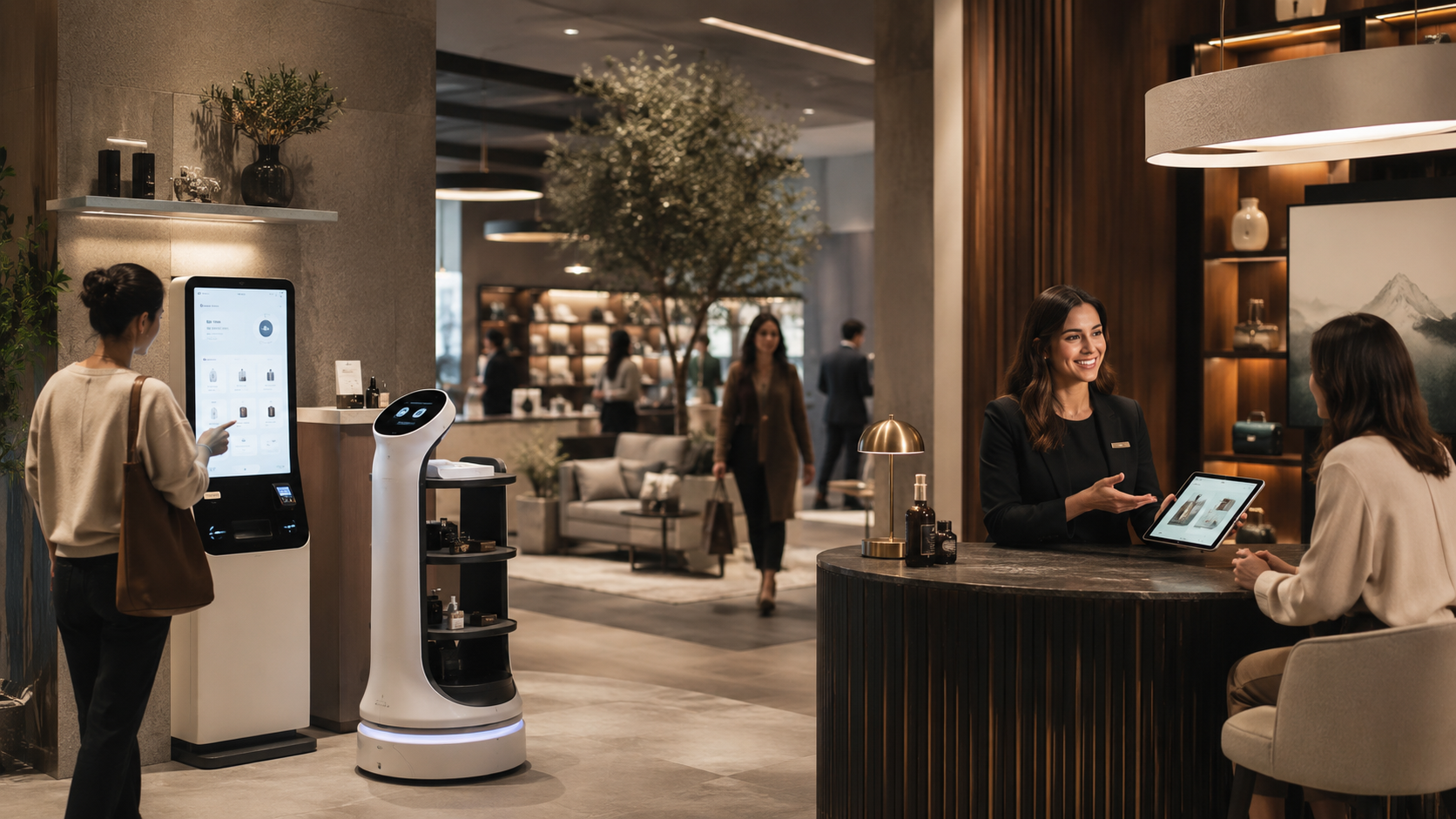
The question is not whether to choose technology or people. It is where each one creates more value.
Some questions are useful to open a conversation, but weak when it comes to making decisions. “Robots vs Humans: who wins the B2C war?” is one of them.
It is a good provocation. It forces us to talk about artificial intelligence, automation, voice assistants, self-service and everything that is already changing the relationship between companies and customers. But when we move from theory to the field, the answer no longer fits into a simple choice.
A call to confirm a reservation is not the same as a complaint. A question about an order status is not the same as a commercial objection. A customer who already knows what they want does not need the same interaction as a customer hesitating between two options.
In B2C, the most useful question is not “robot or human?”. It is this: what moment of the customer journey are we trying to improve?
The mistake of starting with the tool
Many AI decisions start in the wrong place. A company sees a new platform, a productivity promise, a success story from another brand, and the conversation quickly jumps to implementation.
But technology should not lead the journey. The journey should define the technology.
Before buying, automating or redesigning anything, it is worth asking simple questions. Does this moment happen often? Is there risk involved? Can it generate revenue? Does it require trust? Does the customer want speed, or do they want guidance? Is the team spending time where it truly creates value?
These questions sound basic, but they prevent many mistakes. Some companies automate moments where the relationship was the most important part. Others keep people trapped in repetitive tasks because “that is how it has always been done”. And some simply add a new technology layer without solving the confusion that already existed in the process.
Robots win tasks
AI is particularly strong when the request is simple, repetitive and predictable. Confirming reservations. Answering frequently asked questions. Sending reminders. Handling initial triage. Organising requests. Summarising emails. Supporting replies. Updating dashboards. Giving order-status information.
These tasks are not irrelevant. In many cases they are essential to the operation. But not all of them need to consume human time.
Take a simple example: a restaurant receives 50 calls per day for reservations. If each call takes three minutes, that is two and a half hours per day. Over 30 days, 75 hours. In a year, more than 900 hours. It is not difficult to see the automation potential in simple bookings, confirmations or basic changes.
This does not mean every call should be handled by a machine. A regular guest, a special event, a complaint or a sensitive situation may justify a person. The point is different: continuing to use human time on low-value tasks has a real cost.
Automating repetition is not dehumanising. It is removing noise from the operation.
Humans win moments
There are situations where the best answer is not the fastest one. It is the most appropriate one.
When there is hesitation, objection, emotion, complaint or commercial opportunity, humans still have a clear advantage. A good frontline professional does not just answer. They observe, ask, interpret, adapt and recommend.
This matters in B2C because many customers do not arrive with a final decision. They arrive with a need, a doubt, a concern or an intention that is not yet clear. The right conversation can turn a basic purchase into a better-fit solution.
But we should not romanticise the human side either. Having people is not enough. People without method can be inconsistent. People without training avoid recommendations. People without leadership simply process requests. People without indicators do not know where opportunities are being lost.
Humans only win when they are prepared.
That is why the concept of Service-Based Sales matters so much. It is not about selling through pressure. It is about selling through service: understanding the need, explaining options clearly and recommending with context. When this is done well, the recommendation stops sounding like a sale and starts sounding like help.
Customers do not reject technology. They reject bad technology
There is an overly simple idea in this debate: either customers want to speak to a person, or they want self-service. In practice, it depends.
If the request is simple, customers usually want speed. If the problem is sensitive, they want trust. If they are irritated, they want to be heard. If they already know what they want, they want autonomy. If they are undecided, they want guidance.
The problem is not AI itself. The problem is being trapped in an automation that does not understand, does not solve and does not let the customer reach a person.
A poorly designed chatbot can turn a simple question into frustration. A poorly designed voice menu can force a customer to repeat information several times. A closed automation can treat an emotional complaint like a basic FAQ.
Good automation reduces friction. Bad automation creates new friction.
The most interesting model is hybrid
In practice, there are three ways to work.
The first is automatic: AI solves the issue on its own. It works for volume, repetition and low risk.
The second is human: a person leads the interaction. It works for trust, emotion, objection, negotiation and recommendation.
The third is hybrid: AI prepares, the human decides.
This last model is probably the most interesting one for many B2C operations. AI can organise history, identify patterns, suggest the next best action or flag risk. The human uses that information to have a better conversation, adapt the recommendation and create value.
AI does not need to replace the salesperson to improve sales. It can make the salesperson better prepared. It does not need to replace the manager to improve management. It can give better visibility. It does not need to replace customer service to improve experience. It can remove repetitive volume and leave people focused on the right moments.
Hybrid is not a compromise for companies that lack courage. Very often, it is the smartest design.
The real war is organisational
The “robots vs humans” debate is attractive, but the real war is not technological. It is organisational.
It is not enough to install AI. It is not enough to have a chatbot. It is not enough to automate emails. It is not enough to create dashboards. Companies need to redesign processes, roles, metrics and behaviours.
Who owns each moment of the journey? When should AI hand over to a person? Which metrics matter: cost, experience, revenue, retention, conversion? Who follows execution? Who trains the teams? Who guarantees consistency in the field?
Technology can automate tasks. Leadership changes behaviour.
In the end, the most useful answer is not “robots” or “humans”. Robots win tasks. Humans win moments. Intelligent companies win the journey.
The question for any B2C operation is simple: which moments should be automated, which moments should remain human, and which moments need both?