
There are stores we walk into because we need to buy something.
And then there are others we enter with no clear intention to buy at all. A window display catches our attention, a detail makes us stop, there is music, movement, a particular scent, a story, or simply a product presented in a way we did not expect.
This second type of retail is particularly interesting to us.
These are spaces that sometimes achieve something quite rare: they stop being simply the place where we bought something and become part of the memory of the trip itself. Among our favourite photographs from a visit to a city, there may well be that store we happened to walk into without really knowing what we would find.
We may not even have known exactly what it sold.
We went in because we wanted to see.
And at that point, the experience had already begun — long before there was a purchase and, in some cases, before the visitor even knew whether they wanted to buy anything.
This is where Fish! remains relevant.
Inspired by Seattle’s Pike Place Fish Market, the book became widely known for showing how something as ordinary as selling fish could take on a completely different dimension because of the people involved. Choose Your Attitude, Be There, Make Their Day and Play became the four principles associated with that philosophy.
We do not see Fish! as a sales methodology. Its value lies elsewhere: it reminds us that one person can profoundly influence how another experiences a space, perceives a product or remembers a moment.
In retail, that can be extremely valuable.
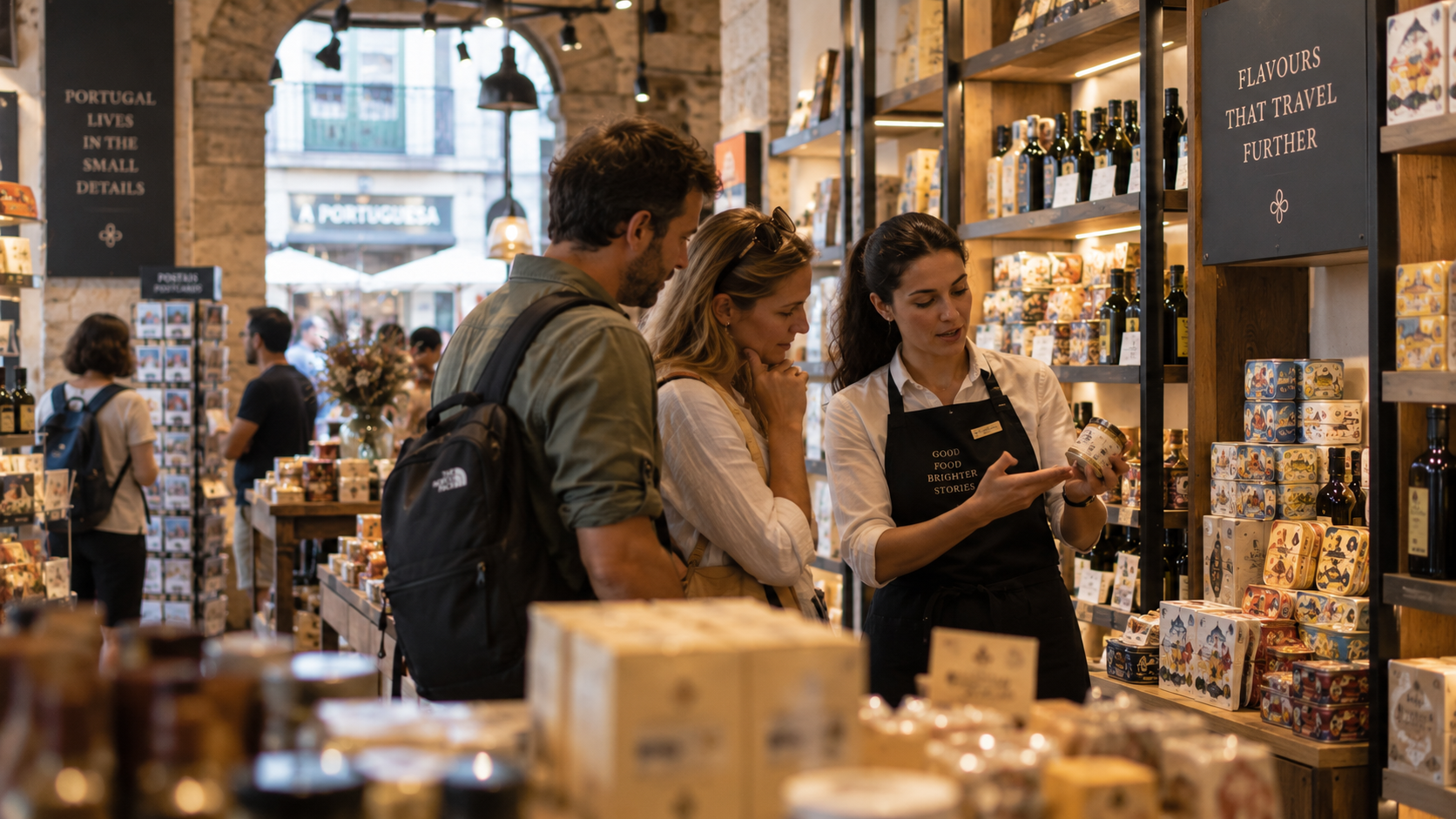
Imagine someone walking into a store selling Portuguese products while travelling. They move slowly through the space, pick up one package, compare it with another, read the back, put it down and continue looking.
They may simply be curious.
They may want a souvenir.
Or they may be trying to choose gifts for several people and have no idea what to buy.
From a distance, all three situations can look exactly the same.
That is why the quality of the interaction begins before any sales technique comes into play.
In some situations, the best thing the team can do is allow the visitor to explore. In others, a small sign of hesitation may justify approaching them.
“Is it for you, or are you looking for a gift?”
Very little more than that may be needed to open up a conversation.
From there, we start to understand the context. Who it is for, what they are looking for, what kind of story they would like to take home, how much they intend to spend, or even what they have not yet discovered.
They may still choose the first product they picked up.
Or they may discover a special edition, a combination or a gift box that makes far more sense for the occasion and carries a significantly higher value.
The average transaction value has increased.
But saying that someone simply “upsold” the customer reduces what happened to a sales technique. Before the value of the transaction increased, there was attention, discovery, knowledge and a relevant recommendation.
Revenue came at the end.
The space creates the promise. People help fulfil it.
The stronger the concept behind a store, the greater the expectation before anyone says a single word.
Architecture, lighting, sound, scent, packaging, merchandising, storytelling. Some spaces are capable of interrupting the normal rhythm of a street for a few minutes and transporting visitors somewhere else entirely.
Then a conversation happens.
“How much is this?”
“15 euros.”
“Are there other flavours?”
“They’re over there.”
“Thank you.”
“Thank you. Have a nice day.”
Nothing went wrong. The service was perfectly correct.
And yet something may have fallen short.
When the entire space has been designed to trigger curiosity, a purely functional interaction can create a noticeable gap between what the brand promised and what the person added to the experience.
This is where Be There becomes particularly interesting.
Being present does not mean approaching every visitor or trying to turn every movement into a commercial opportunity. It means understanding the moment more accurately.
A tourist may simply be choosing a product. Or they may be choosing the object they will pack in their suitcase and still associate with that trip months later.
Physically, it may be exactly the same package.
Its meaning is different.
That requires teams that know the product and its story, of course, but above all can adapt. To the person, the moment, the time available and the level of interest.
Some customers want a story.
Others want a recommendation.
And some simply want to continue exploring in silence.
Knowing how to tell the difference is part of the experience.
When some visitors become invisible
Experiential retail spaces have a particularly interesting characteristic: they can generate significant footfall without there necessarily being a clear intention to buy.
People walk in because the store is beautiful, because someone recommended it, because they saw others taking photographs, or simply because something in the window caught their attention.
That makes conversion more complex to analyse.
Not everyone who leaves without buying represents a lost opportunity. Some had no intention of buying anything and probably never would have.
But others are different.
In some contexts, we refer to them as ghost customers.
Not because they do not buy, but because they move through almost the entire experience without us ever really understanding who they are or what they are looking for.
They pick up different products, compare them, return to the same shelf, look around for information, spend time in one area. Then they leave.
Could they have bought something?
Perhaps.
And that “perhaps” is precisely what makes the phenomenon interesting.
In a business that has invested so much in getting someone to stop, enter and stay, it is worth understanding how many visitors showing clear signs of interest never have a meaningful interaction with the team.
Revenue may be escaping long before there is any opportunity to discuss upselling.
The answer is not to approach everyone. In a store of this kind, that could destroy exactly what makes the visit enjoyable.
The answer lies in becoming better at noticing.
There is an important difference between giving someone space and simply failing to see them.
The experience is also built into the offer
Not all growth potential lies with the people on the shop floor.
Sometimes the customer is interested, the team does everything well, and yet something is still missing from the offer itself.
Imagine someone wanting to take a Portuguese souvenir home for a family. They find several products they like, but no combination designed for that occasion. Or they try a product in a food retail concept, enjoy it and would like to take part of that experience home, but no simple solution has been designed to allow them to do so.
At that point, we are no longer talking only about selling.
We are talking about product.
A well-designed pack can simplify a decision. A special edition can turn an object into a keepsake. A combination of products can encourage discovery while naturally increasing the average transaction value. A premium experience may appeal to a visitor looking for something beyond the most popular product.
Creating these solutions purely to increase ticket value would mean starting from the wrong place.
The more interesting question is: is there something that would genuinely make sense for the customer, but that we are not yet giving them the opportunity to buy?
When the answer is yes, there may be room for new products, packs, experiences or different ways of presenting what already exists.
Commercial growth sometimes begins long before the conversation at the point of sale.
It begins with designing a better offer.
More conversion is not enough. Neither is a higher average ticket.
There are three very different ways to find growth in this type of operation.
A store can convert more of the traffic it already receives. It can increase the value of some transactions through more relevant recommendations. And it can create new reasons to buy through products, packs or experiences that did not previously exist.
In theory, it sounds straightforward.
In practice, none of these levers should be analysed in isolation.
A higher average transaction value may mean that the team is recommending better. It may also mean they have simply learned to push harder.
A strong conversion rate may indicate an extremely effective operation, but in a highly tourist-driven space it may tell us little unless we first understand the nature of the footfall.
And high satisfaction is an excellent indicator, yet it can coexist with an extremely passive operation where customers receive exactly what they ask for and rarely discover anything beyond it.
That is why the numbers need one another.
Revenue, conversion, average transaction value and products per transaction help us understand commercial performance. Satisfaction, reviews, complaints and loyalty offer another perspective on what we are building.
When several of these metrics improve at the same time, the conversation becomes far more interesting.
Because perhaps we are not simply selling more.
Perhaps we are creating more value.
The best moments rarely need to be spectacular
Make Their Day is another of the principles behind Fish! and perhaps the one we most easily associate with creating memorable experiences.
Not every memorable moment needs to be extraordinary.
Sometimes someone tells us a twenty-second story that completely changes the way we see a product. They recommend something we would never have found on our own. They understand what we are looking for without forcing us into a long conversation, or solve a small problem just as we were beginning to give up.
These are relatively ordinary gestures.
Because they are ordinary, they can happen often.
And perhaps that consistency is what distinguishes a genuinely strong experience from a collection of carefully designed “wow” moments intended to impress.
We do not need to assign five or ten euros of value to each of these interactions. We can look for patterns instead.
When the quality of conversations improves, do fewer visitors pass unnoticed? Does conversion change? Is there more product discovery? Do certain packs begin to perform better? Does average transaction value increase? Do customers mention the team, the recommendation or the experience more often in their reviews?
At that point, Customer Experience begins to move beyond the purely emotional and into performance.
Between what we design and what actually happens
Training matters, but it does not solve everything.
Someone may know every detail of a brand’s story and still struggle to turn that knowledge into a natural conversation. Another person may have tremendous empathy but avoid recommending a higher-value option because they are afraid of sounding too commercial. There are also technically excellent employees who, after hundreds of similar interactions, gradually turn the customer journey into something overly predictable.
And the problem is not always the team.
It may lie in the process, pricing, the way products are presented, a pack nobody understands, an experience that is difficult to explain, or simply an offer that does not yet respond to some of the purchasing occasions already present in the business.
That is why, at Max Revenue Consulting, we are interested in the space between the experience a company intends to create and the one the customer actually lives.
Sometimes that means training and coaching.
In other cases, it requires observing the operation, reviewing processes, analysing how choices are presented or creating new products, packs and experiences.
What matters most comes afterwards: understanding what changed.
Are fewer relevant visitors passing unnoticed? Have recommendations become more natural? Is storytelling helping customers understand what they are buying? Are there new reasons to choose a higher-value option? Has the average transaction value moved? And what happened to customer satisfaction?
Those questions tell us far more than a training session that received excellent feedback at the end of the day.
Fish! does not teach us how to increase revenue.
Nor does it need to.
It reminds us that people can transform what might otherwise be an entirely ordinary transaction into an experience someone remembers.
In a form of retail where the store itself can become part of the journey, that takes on another dimension.
The space can make someone stop. The story can bring them inside. A product can trigger curiosity.
Then there comes a moment when the brand has to bring everything together.
A person, a recommendation, a story, a product or an experience designed for that occasion can turn curiosity into a purchase.
Sometimes that purchase will be worth more than the visitor imagined spending when they walked in.
When that happens because they found more value — not because they felt more pressure — Customer Experience and revenue stop looking like separate objectives.
They are simply two outcomes of an experience designed well.